
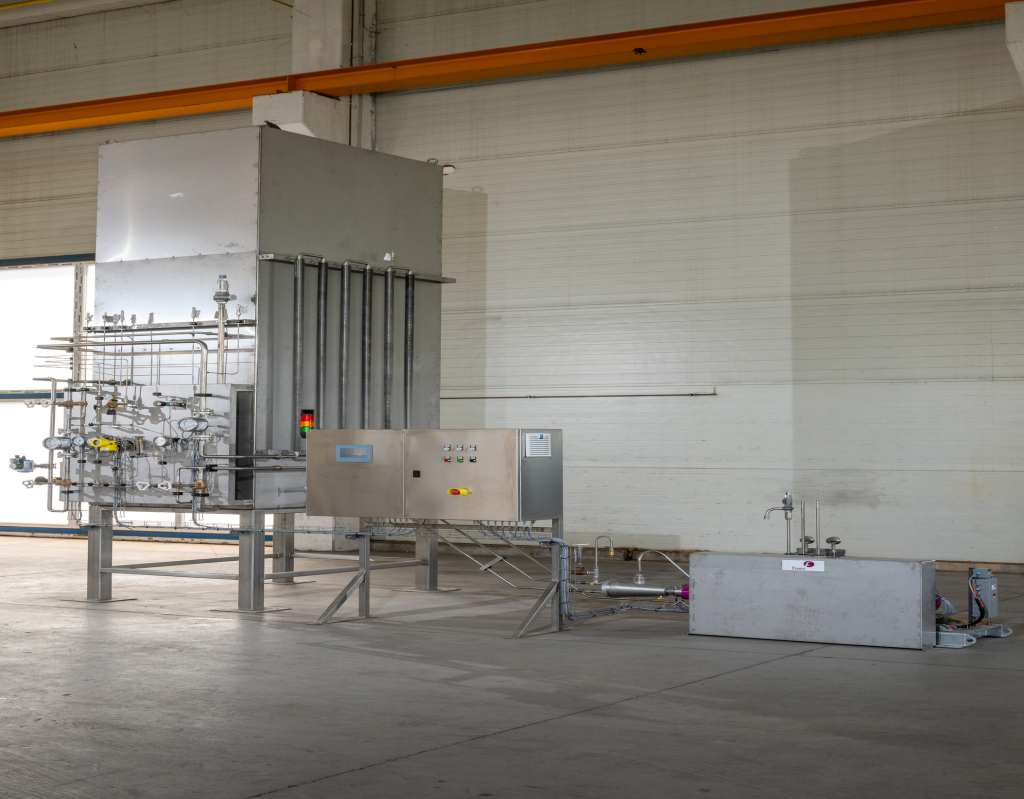
High Purity and UHP Gas Equipment: Specs and Selection
UHP gas equipment is built to hold specific impurities below 0.1 parts per million, using 316L electropolished stainless steel, controlled surface roughness, orbital-welded or VCR joints, and full batch traceability. High purity equipment sits a step below that, adequate for less critical applications but not for advanced-node process gas. If you are specifying or buying gas delivery equipment for a semiconductor line, the difference between the two is not marketing language. It is the difference between equipment that protects yield and equipment that quietly erodes it.
This guide sets out the specs that actually matter, how to choose the right configuration, and what to check before you sign off on a supplier.
What UHP Actually Means in Numbers
“Ultra-high purity” is not a vague quality claim. It refers to a defined standard: specific impurities held below 0.1 parts per million (ppm) in the gas itself, backed by equipment that will not add contamination back in. In practice, some processes push far beyond that. Advanced 3D NAND fabs, for example, run nitrogen at up to 99.999% purity through volumes reaching 100,000 Nm³ per hour, and next-generation gas analysers using atmospheric pressure ionisation mass spectrometry can now detect impurities down to parts-per-trillion levels for continuous monitoring.
High purity equipment, by contrast, is usually built to a looser tolerance and is common in applications where absolute purity is important but not process-critical. The mistake worth avoiding is assuming the two terms are interchangeable when writing a spec. They are not, and a supplier who does not ask which one you need has not understood the brief.
The Specs That Actually Matter
Material and Grade
316L stainless steel is the standard material for UHP tubing, fittings and panel components, chosen for its resistance to the acids and chlorides common in semiconductor process gases. UHP-grade material is produced with tighter mill-level control over sulphur, phosphorus and metallic inclusions than standard 316L, and this should be confirmed with mill test reports, not taken on trust.
Surface Finish
Internal surface roughness is one of the most commonly under-specified details in a gas system. Most UHP specifications call for an internal surface roughness (Ra) of 10 microinches or less, achieved through electropolishing, an electrochemical process that removes microscopic surface irregularities and improves the stability of the passive oxide layer. Rougher surfaces trap particles and moisture, and both will show up later as contamination events rather than immediate faults, which makes this an easy spec to skip and an expensive one to have skipped.
Joining Method
Orbital-welded joints and VCR face-seal fittings are the two accepted methods for UHP assemblies. Fewer joints generally means fewer leak points, which is why long continuous coiled tubing runs are increasingly preferred over multiple short lengths stitched together on site. Welding procedures should conform to recognised codes such as ASME, with qualified welders and documented procedures, not ad hoc fieldwork.
Testing and Traceability
A UHP assembly should be certified through particle counting, moisture testing and conductivity or cleanliness measurement before it is accepted, and components should arrive cleaned, capped and bagged in a rated cleanroom environment rather than assembled loose on site. Reference standards such as SEMI F20 and ASTM A270 cover these requirements for tubing, and a supplier should be able to point to exactly which standard each component meets, not just say it is “semiconductor grade.”
Choosing the Right Configuration
Getting the material spec right is only half the job. The system architecture around it matters just as much.
Standalone panels versus valve manifold boxes (VMBs). A VMB centralises the switching, monitoring and safety functions for multiple gas sources in one engineered enclosure, and is increasingly the default for fabs handling more than a handful of specialty gases, since it reduces the number of individual connection points and gives a single point of control. JDLL’s UHP gas delivery units are engineered around this kind of centralised, project-specific configuration rather than assembled from generic parts.
Automatic versus manual changeover. Manual changeover is cheaper and simpler, but automatic changeover reduces the risk of a supply interruption during a source swap, which matters more as fabs run closer to continuous production. This is a genuine cost-versus-risk decision and should be made deliberately, not defaulted to whichever option the quote happened to include.
Point-of-use purification. Even a well-specified gas supply picks up trace moisture and airborne molecular contaminants between the source and the tool. Point-of-use purifiers are placed as close to the process chamber as practical to strip out these final traces, and are now considered standard practice on advanced-node lines rather than an optional extra.
Moisture control upstream. Where a gas is generated or conditioned on site rather than delivered pre-purified, gas drying units remove moisture to the specification the downstream process requires, and should be sized to the specific gas type and flow rate rather than fitted as a generic add-on.
What Happens When the Spec Is Wrong, and Why Sourcing Resilience Now Matters Too
Contamination from an under-specified gas system rarely announces itself immediately. It tends to surface later as yield loss, parametric drift, or a reliability failure that is hard to trace back to its source, particularly as device geometries shrink and the acceptable defect margin per process step approaches zero. Getting the spec right at the design stage is far cheaper than diagnosing a contamination excursion after the fact.
2026 has also been a reminder that gas equipment specification is not the only variable. In March 2026, the closure of the Strait of Hormuz following regional conflict disrupted helium exports from Qatar’s Ras Laffan facility, one of the world’s largest helium production hubs, and Qatar had supplied roughly a third of global helium output. Helium is used in semiconductor fabs for leak detection, as an inert carrier gas in deposition, and for wafer cooling during thermal processes, and no substitute gas replicates its combination of inertness, small atomic size and thermal conductivity across those roles. South Korean fabs, which had sourced a large share of their helium from Qatar, were reported to be running down inventory buffers as the disruption continued, while U.S. producers and new capacity in Taiwan offered only partial relief given the scale of Qatar’s former output.
The direct lesson for gas equipment planning is not about helium specifically. It is that supply resilience, not just equipment quality, is now part of the specification conversation. A well-built UHP system fed by a single, undiversified gas source still carries risk. This is one more reason sourcing control and supply chain visibility, not just hardware design, belong in a supplier evaluation, alongside the turnkey engineering and sourcing services a genuine specialty gas partner should offer.
Selection Checklist for a UHP Gas Equipment Supplier
Before signing off on a supplier, confirm:
- They can state, in writing, which purity grade and which standards (such as SEMI F20 or ASTM A270) each component meets, rather than a general “UHP compliant” claim.
- Surface finish, material certification and joining method are documented per assembly, with mill test reports and cleanroom packaging evidence available on request.
- The system is designed around your actual process conditions and KPIs, not selected from a generic catalogue.
- Automation, monitoring and safety architecture, including SIL-rated safety systems where relevant, are built in from the design stage rather than added afterwards. JDLL’s approach to this is set out on the safety and quality page.
- The supplier controls or has direct visibility into its own manufacturing and sourcing chain, rather than depending entirely on third-party fabrication with variable quality and lead times.
JDLL has delivered specialty gas systems, including UHP delivery equipment, across 20 countries over the past 25 years, working from its own manufacturing and automation partners rather than outsourced fabrication. More on the company’s background is available on the About JDLL page.
FAQs
What is the difference between high purity and UHP gas equipment?
High purity equipment is built to a looser impurity tolerance and suits applications where cleanliness matters but is not process-critical. UHP (ultra-high purity) equipment is built to hold specific impurities below 0.1 parts per million, using UHP-grade 316L stainless steel, electropolished internal surfaces and full batch traceability, and is required for advanced semiconductor process gas.
Why does surface roughness matter so much in UHP gas systems?
A rough internal surface traps particles and moisture, both of which can be released back into the gas stream during operation. Most UHP specifications require an internal surface roughness of 10 microinches or less, typically achieved through electropolishing, since even a technically pure gas will pick up contamination from a poorly finished delivery system.
Should I choose orbital-welded joints or VCR fittings?
Both are accepted UHP joining methods. Orbital welding suits long, continuous runs where minimising joints is the priority, while VCR face-seal fittings are useful where components need to be removed or serviced without cutting into welded tubing. The right choice depends on the layout of the specific system and how often parts of it will need to be accessed.
What should be included in a UHP equipment acceptance test?
A UHP assembly should be certified through particle counting, moisture testing and conductivity or cleanliness measurement before acceptance, with results documented against the relevant standard. Components should also arrive with mill test reports and evidence of cleanroom packaging, not just a general compliance statement.
Does gas supply disruption affect UHP equipment selection?
Yes. Equipment quality only protects part of the process. If a critical gas such as helium becomes constrained, as happened in 2026 following the Strait of Hormuz closure and its impact on Qatari helium exports, even a well-specified system depends on the reliability of its supply source. Supply chain visibility and sourcing diversity should be part of the same evaluation as the hardware spec itself.
Specifying UHP gas equipment correctly, and choosing a supplier who can prove they meet that spec rather than simply claim it, is what protects yield over the life of a system. Contact JDLL’s engineering team to talk through your specification.